Destination

Marrakech

The Red City — Where Every Alley Is a Story

Morocco · North Africa Best: Oct–Apr

The Labyrinth of the Senses

Founded in 1062 by the Almoravid dynasty, Marrakech is one of North Africa's oldest imperial cities. Its signature rose-red walls — built from the local pise clay — give the city its enduring nickname and a warm, almost otherworldly glow in the late afternoon sun. For nearly a thousand years, Marrakech has been a crossroads of Berber, Arab, and sub-Saharan African culture, a place where caravans unloaded their goods from across the Sahara.

The UNESCO-listed medina is one of the best-preserved historic city centres in the Arab world. Within its medieval walls, a dense network of souks (markets), mosques, madrasas, fondouks (merchants' inns), and hammams has functioned continuously for centuries. Here, tanners still cure leather using methods unchanged since the 11th century, and copper workers beat intricate patterns by hand in workshops that have served the same families for generations.

At the heart of the medina lies Jemaa el-Fna square, described by UNESCO as a "Masterpiece of the Oral and Intangible Heritage of Humanity." By day, orange juice sellers and snake charmers occupy the space; as evening falls, it transforms into a vast open-air theater of storytellers, musicians, acrobats, and food stalls — a living institution with no script and no admission charge.
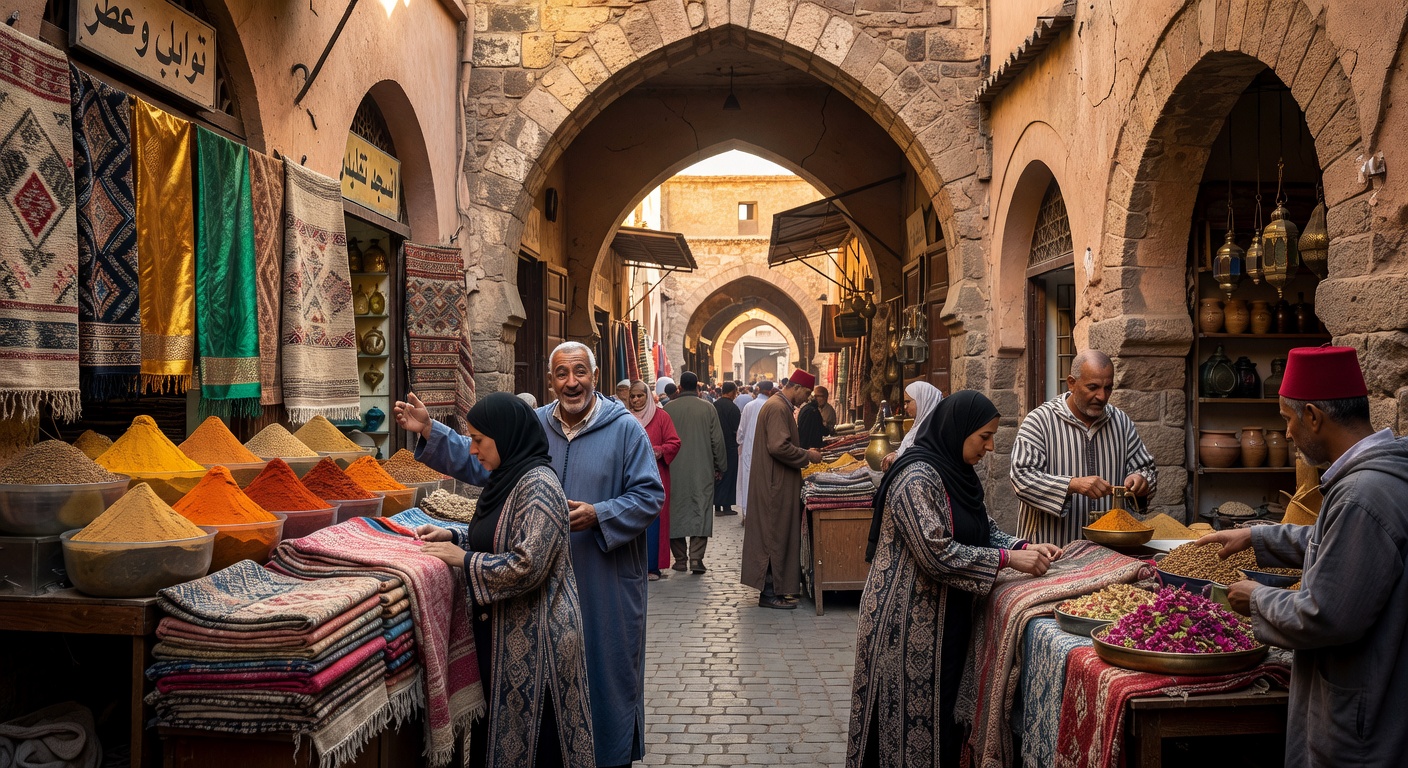
Moroccan souk market in Marrakech
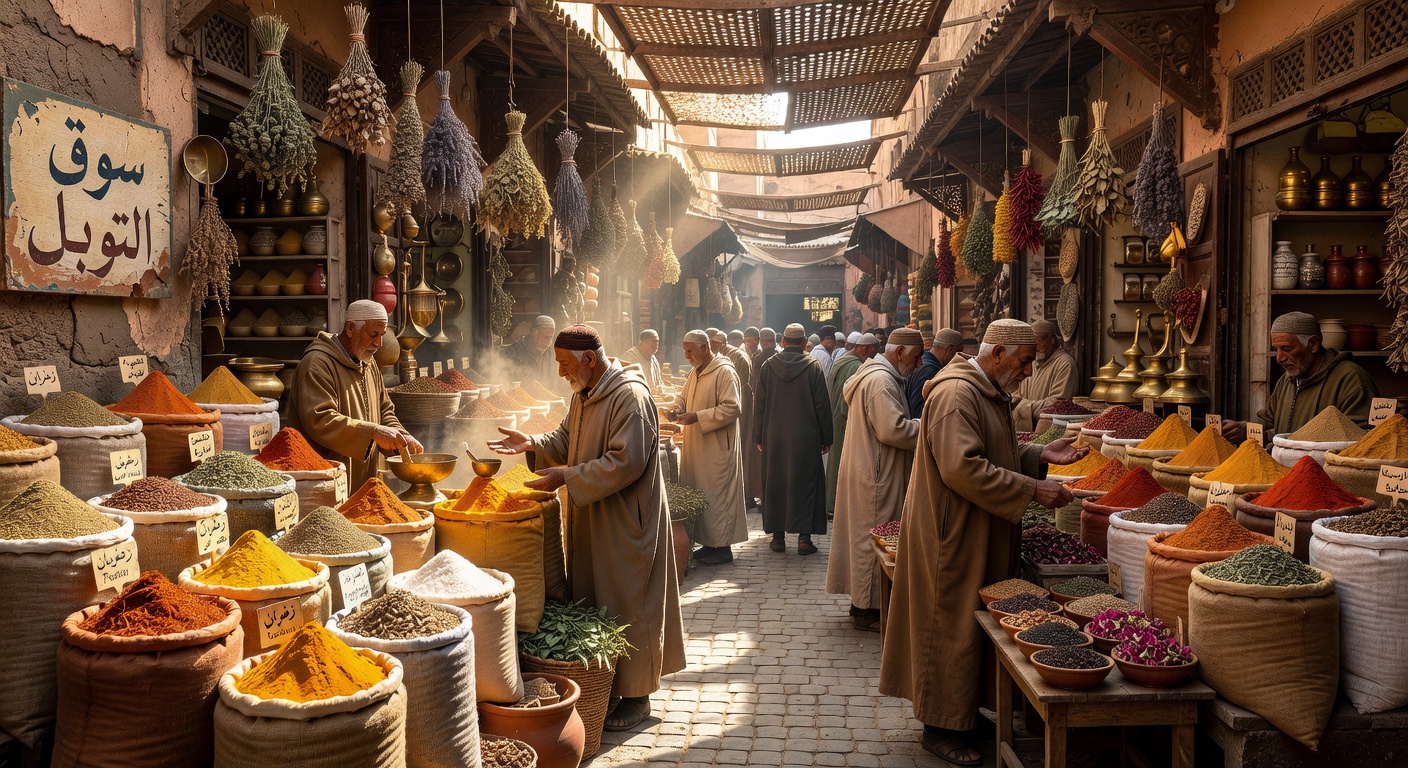
Moroccan spice souks

The spice souks of Marrakech — a palette of saffron, cumin, ras el hanout, and dried roses that has barely changed in a millennium.

Life Inside the Walls

The Souk Quarter

The souks of Marrakech are organised by trade guild — a medieval system still intact. The Souk des Teinturiers is for dyers, the Souk des Babouches for leather slippers, the Souk des Bijoutiers for jewellery. Each quarter has its own rhythm, sounds, and smells, creating a city within a city that rewards extended, unhurried exploration.

The Riads

The traditional courtyard house of the medina — the riad — presents a blank facade to the outside world and opens inward onto a garden or fountain courtyard. This architectural inward-turning reflects Islamic values of privacy and domestic sanctuary. Many riads have been sensitively restored and now operate as intimate guest houses, offering the most authentic way to experience medina life.

The Hammam Culture

The neighbourhood hammam is a social institution as much as a bathing house. Segregated by gender, the public hammams of the medina serve entire communities — a place of gossip, relaxation, and ritual cleansing. The traditional scrub with a kessa mitt and application of black beldi soap is a bodily experience unlike any spa treatment, and the neighbourhood hammam remains the living pulse of daily medina life.

What to Experience

Gnawa music performance
Music Tradition

Gnawa Music

The Gnawa tradition originated with sub-Saharan African peoples brought to Morocco centuries ago. Its hypnotic, repetitive rhythms — played on the guembri bass lute and metal qraqeb castanets — are embedded in a spiritual ceremony called a lila, intended to heal through music and trance. Recognized by UNESCO as Intangible Cultural Heritage of Humanity, Gnawa music is one of Morocco's most extraordinary living traditions, experienced most purely in Marrakech and Essaouira.

Artisan workshops in the medina
Craft Heritage

Artisan Workshops

The medina's craftspeople represent an unbroken chain of master-apprentice transmission stretching back centuries. The tanneries — best viewed from the balconies of surrounding leather shops — show workers treading hides in ancient stone vats of pigeon dung, quicklime, and natural dyes. Woodcarvers in the Souk des Moukaouinine produce intricate geometric latticework, while metal workers in the Souk Haddadine hammer copper and silver into lamps and tea services.

اتاي
Daily Ritual

Mint Tea Ritual

The Moroccan tea ceremony is a three-act drama of hospitality. The first glass is poured bitter as death — the tea steeped long and strong. The second is poured strong as life — the tea cut with mint. The third is sweet as love — the sugar heavy and generous. Refusing tea is refusing friendship. Poured from a great height to create froth, the ritual belongs equally to a Berber tent in the High Atlas and a rooftop riad in Marrakech.

حلقة
Living Tradition

Storytelling at Jemaa el-Fna

The ancient art of halqa — circle storytelling — is still practised daily in Jemaa el-Fna square, where a crowd gathers around a standing narrator who weaves tales from Islamic folklore, Berber legend, and improvised comedy, passing a hat when the story reaches its climax. It is one of the world's last surviving forms of public oral literature, a tradition so vital to human cultural expression that UNESCO moved to protect it before even creating the broader framework for intangible heritage.

Moroccan Table

Moroccan cuisine is a record of trade routes, empire, and the long conversation between Berber, Arab, Andalusian, and sub-Saharan African foodways.

Tagine

The conical clay vessel that gives the dish its name functions as a slow-cooking oven, trapping steam and returning moisture to the ingredients. A chicken tagine with preserved lemon and olives, a lamb tagine with prunes and almonds — these are not restaurant food but family food, cooked for hours and eaten with bread, never cutlery. The tagine is the taste of Moroccan domestic hospitality.

Couscous

Every Friday, across Morocco, the smell of couscous drifts from windows after the midday prayer. The Friday couscous is a family and religious institution — the hand-rolled semolina steamed three times over a broth of vegetables and meat, heaped in a pyramid and eaten communally from one platter. Offering couscous is an act of generosity; refusing it is almost inconceivable.

Street Food at the Square

After dark, the food stalls of Jemaa el-Fna offer a festival of Moroccan street food. Vendors ladle snail soup from steaming cauldrons, squeeze fresh orange juice from pyramids of fruit, and present whole sheep heads — slow-cooked until tender — alongside merguez sausages, harira soup, and msemen flatbreads. Eating here is not a tourist experience — it is participation in a living institution.

Culti Travel Notes

Navigating the Medina

The medina was not designed to be understood at first visit — its apparent confusion is its structure. Allow yourself to become lost, and use the minarets as compass points. A good local guide is invaluable for a first visit; thereafter, wandering without direction is the most rewarding approach. The major souks are clustered north of Jemaa el-Fna and can be navigated in sections.

Dress & Etiquette

Marrakech is a predominantly Muslim city with conservative dress norms in the medina. Both men and women should cover shoulders and knees when visiting mosques, shrines, and religious sites — and as a courtesy in the medina generally. Photography of people requires permission; many residents, particularly women, strongly prefer not to be photographed. Entering a mosque interior is generally not permitted to non-Muslims.

Best Time to Visit

October to April is the optimal window, with mild temperatures and low rainfall. March and April bring spring blossoms; November and December offer clear skies and thinner crowds. Summer (June–August) brings intense heat exceeding 40°C, which makes exploration difficult. Ramadan — the date shifts each year — transforms the medina profoundly: quieter by day, extraordinarily alive by night.

Discover More

Marrakech is a gateway to North African and Moroccan culture in its fullest depth.

Culti